Template Objective
The Machine Sales Process template allows you to track the entire lifecycle of a machine deal, from the commercial phase through to commissioning and customer training.
Each project stage is tracked with its responsible department, stakeholder (manufacturer or customer), progress status, and planned duration. The board thus provides a cross-functional view of all teams involved — Sales, Engineering, Production, Logistics, Installation, Support — on a single deal.
It is particularly suited to manufacturers who produce and deliver custom or semi-custom equipment, and who need a shared management tool between internal teams and the customer.
Create a Board from the Template
- In the workspace of your choice, click on "Add a new board".
- Access the INDUSTRY template category and search for the "Order-to-Delivery Process" template.
- To discover the template's features, start by importing the test data. This will allow you to visualize a concrete example and quickly familiarize yourself with the structure. Once ready, you can switch to a blank template to create your own personalized board.
Board structure
Each row represents a step in the Order-to-Delivery process for a given project.
Process phases
The board is organized into 5 sequential phases covering the entire cycle:
| Phase | Description |
|---|---|
| 1. Customer requirements specification | Constraint analysis, option definition, specifications validation |
| 2. Design & Manufacturing | Technical design, manufacturing, quality control and workshop testing |
| 3. Preparation & Delivery | Logistics, transport, site preparation and unloading |
| 4. Installation & Commissioning | Positioning, connection, configuration, live testing and acceptance sign-off |
| 5. Training & Support | Operator and maintenance training, documentation handover, project closure |
Template Attributes
| Attribute | Type | Description |
|---|---|---|
| Stage | Text | Name of the stage in the process. |
| Stage ID | Text | Reference identifier for the stage. |
| Phase | List | Phase of the Order-to-Delivery process to which the stage belongs. |
| Department | List | Team responsible for the stage (Sales, Engineering, Production, Logistics, Installation, Quality, Purchasing, Support, Safety, Delivery). |
| Stakeholder | List | Main actor involved in the stage (Manufacturer or Customer). |
| Owner | User | Person responsible for the stage within the organization. |
| Status | List | Progress of the stage (To be planned, In progress, Awaiting feedback, Completed, Delayed, Out of scope). |
| Start Date | Date | Planned start date of the stage. |
| End Date | Date | Planned end date of the stage. |
| Duration (days) | Number | Estimated duration of the stage in working days. |
| Milestone | Text | Indication of a key milestone associated with the stage. |
| Milestone | List | Marks the stage as a project milestone visible in the planning view. |
| Key Actions | Checklist | List of actions to be completed to finish the stage. |
| Modified Date | Date | Date of last update to the stage (automatic). |
Views Included in the Template
Project Stages
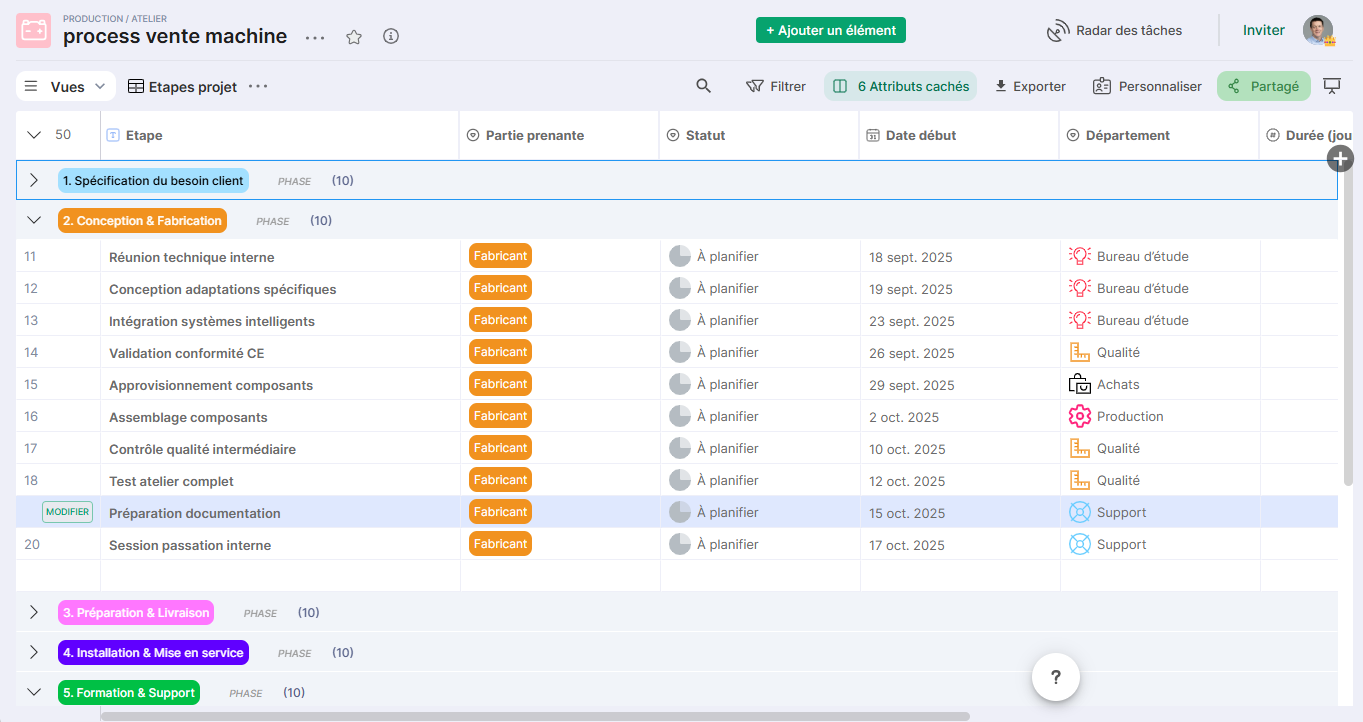
Table view displaying all process steps with their attributes: phase, department, stakeholder, status, dates, and owner.
Reference view for daily operational suivi and project reviews.
Step by Phase
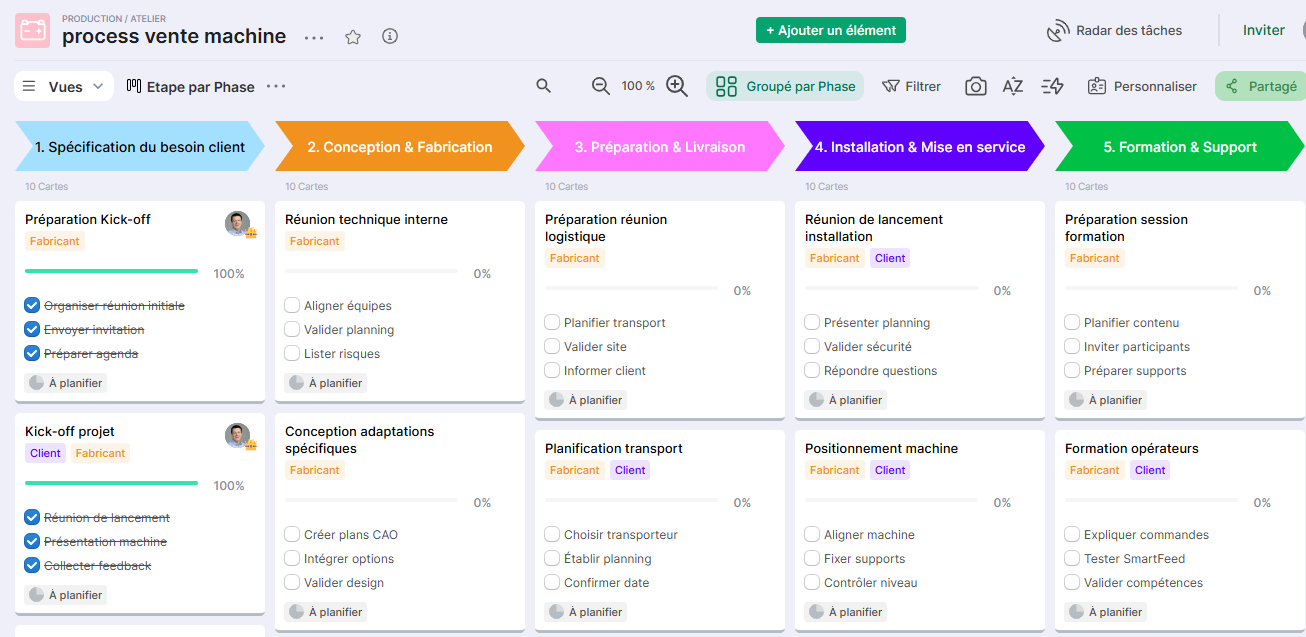
Kanban view grouping steps by Order-to-Delivery process phase.
Allows you to visualize the overall progress of each phase and quickly identify blocked or delayed steps within a given phase.
Project Schedule
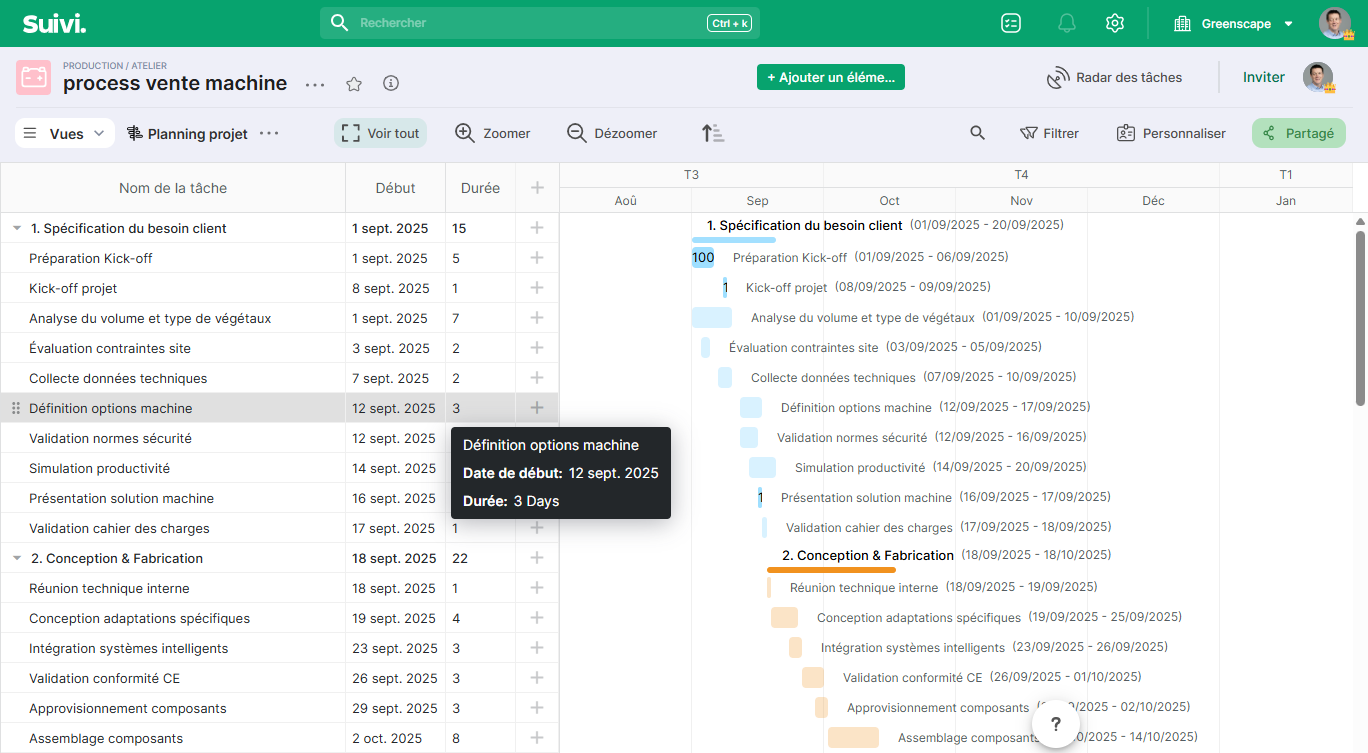
Gantt view displaying the complete sequence of steps as timeline bars, with milestones highlighted.
Ideal for managing the overall project timeline, anticipating dependencies between steps, and communicating the schedule to the client.
Department Requests
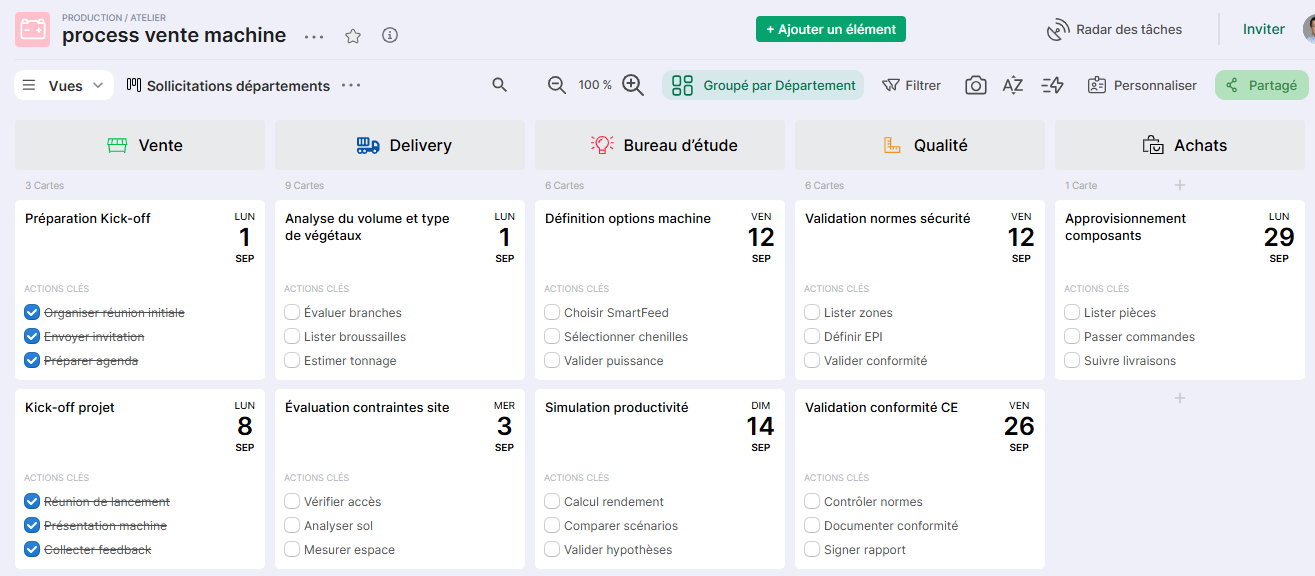
Kanban view grouping stages by department involved.
Allows identifying each team's workload on the project and ensuring that no department is engaged without visibility into their responsibilities.
Conclusion
The Order-to-Delivery Process template provides a structured framework for managing a machine project end-to-end, associating each stage with the right department, the right stakeholder, and the right level of visibility.
It can be duplicated for each new project and adapted according to the machine's complexity, the client's specific requirements, or the steps unique to your manufacturing process.